Metastatic Breast Cancer Awareness Day

October 13, 2025

Today is Metastatic Breast Cancer Awareness Day. We get this one day in breast cancer awareness month to shine a light on MBC.

1 in 3 of women cured of breast cancer
will be diagnosed as stage IV (MBC), which is terminal.

If we cure Stage IV, we cure all breast cancer.

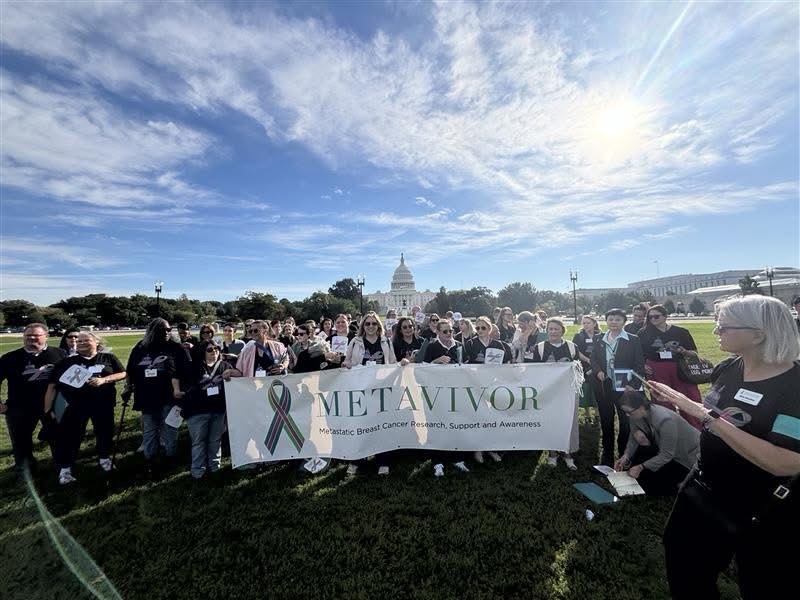
In support of raising awareness for MBC, I went to Washington D.C. last week and participated in the METAvivor Stage IV Stampede and Summit.

The Summit included a day of education about MBC as well as how to advocate for various bills and funding.

Tuesday we marched (with police escort) from our hotel to the Capitol. We had a remembrance on the grass. I am holding the sign on the end, near the last “R”. We spoke the names of those who have died from MBC (and I included my aunt Jeanne Moretti as well as several other friends who have passed).

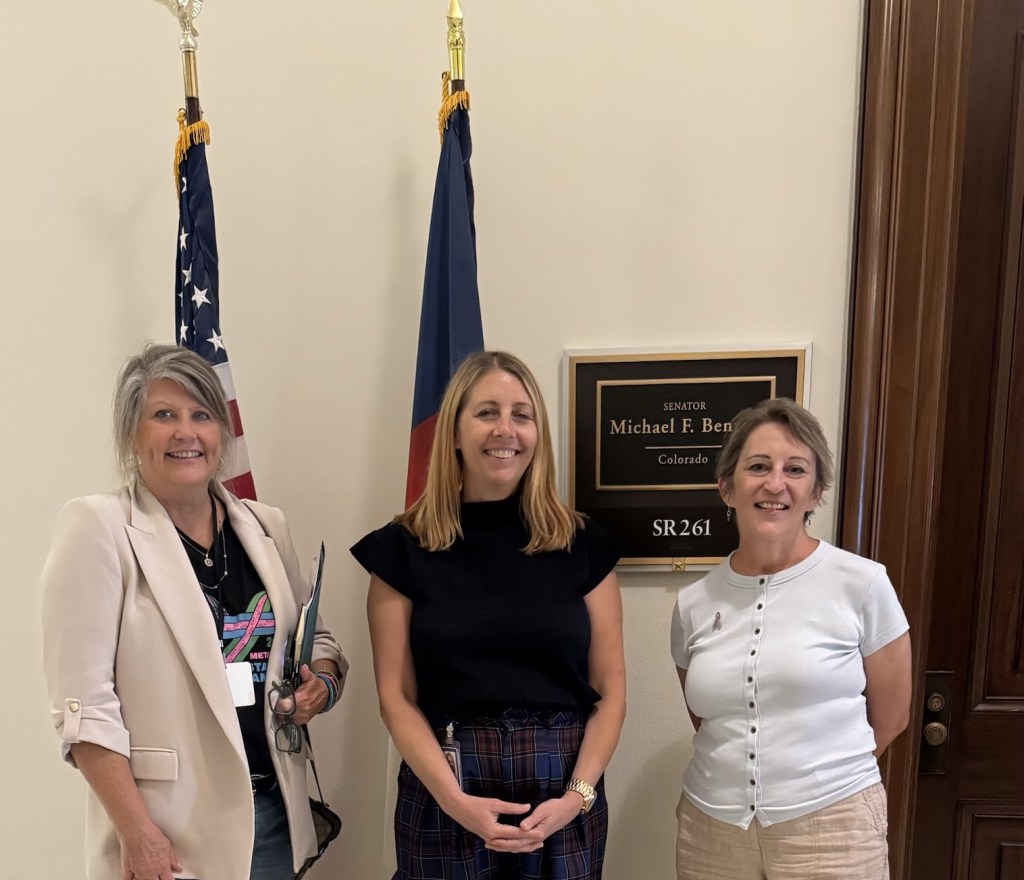
Policy advocates preparing to visit with Congressional staffers.

We met with staffers of our elected representatives. Staffers were taking meetings even though the House was not in session and the federal government was/is closed.

There were four “asks” that we made. I had fantastic interactions and felt like I was heard. I’ll share here what those asks were – if you feel compelled to share with friends/family or to reach out to your own elected representatives that would mean a lot.

  • Did you know that if you have MBC and need to stop working there is 5-month waiting period for Social Security Disability Insurance (SSDI) benefits to start? In addition, after that there is a 24-month waiting period before you are eligible for Medicare! I am one of the fortunate people who is living longer with my MBC diagnosis and can still work. Women with different subtypes have a prognosis of 2-3 years. During this time they can’t work and can’t get SSDI or Medicare. House bill 2048 “Metastatic Breast Cancer Access to Care Act” would eliminate the waiting period.
  • Did you know that where you live impacts how private insurance pays for MBC drugs? Private insurance treats medication received at a cancer center different from medication taken at home. Recall that I was on a pill (Ibrance) for the first 4 years. I live in a state where private insurance is required to pay for this (chemo) regardless of how it is given: intravenous or a pill. House bill 4101 (Cancer Drug Parity Act) would require private insurance to cover oral cancer drugs the same as IV drugs, regardless of what state you live in.
  • The U.S. is the largest funder in the world of cancer research. The administration’s budget zeroed out some breast cancer research programs and greatly reduced funding for the National Institutes of Health (NIH). Fortunately, Congress likes science – we asked them to provide the NIH with the same funding as last year and restore the breast cancer program in the Dept. of Defense.
  • Did you know there is a national database of incidence of cancer? It was created in the ‘70s during the Nixon administration. Unfortunately, it has not been updated since then. The Surveillance, Epidemiology and End Results (SEER) database provides information on cancer statistics which is used to inform where research dollars should go. It needs to be updated badly and I asked our reps to support funding for it. SEER help us understand where there is a high burden of cancer. It turns out that not every state is contributing to it. In addition, it does not include any recurrence of cancer. When I was first diagnosed, my information was put into SEER (LCIS and stage 0 DCIS breast cancer). However, there is no mechanism to update my information! According to SEER I was treated in 2009 and all is good with me. As you can see, the number of people with MBC or with any recurrent cancer are not counted which means we have no idea who is living with metastatic disease (unless you were diagnosed with MBC right away, which is only 6% of all MBC diagnoses).

That was a lot! If you are still reading, thank you. If you’d like more information about anything including language to send to your elected representatives, shoot me an email (charlevo@gmail.com).

I have one other cancer event this week and then I will take a break from cancer the rest of this month. I hope you are keeping balance in your life as well.

Onward!

1. Donate to research for MBC via METAvivor.

2. Find your Congressional representatives: House & Senate

Busy September capped by radiation ☢️

October 11, 2025

September was a busy month for me in managing cancer.

Back in June I had a brain MRI, which includes the very top of your spine (cervical). At that time, it looked like there might be an active tumor in part of my C1 vertebrae. I also had a full body PET scan that showed “stable” cancer at the time (mainly my spine has been problematic).

The stable PET scan means that my treatment (Enhertu) is largely working. However, the tumor on my C1 made me nervous. Your C1 is directly at the back of your head at the height of your nose. If anything goes wrong there it can be complicated and in the words of my oncologist “catastrophic” 😳

After discussing with my oncologist in August, we decided to radiate it. It’s not uncommon with metastatic breast cancer (MBC) to consider radiating smaller tumors if everything else is stable or no evidence of disease (NED).

So, I decided to pack this in to September which was already busy.

After another MRI of my cervical spine I met with a radiation oncologist. He wanted to do Stereotactic external Beam Radiation Therapy (SBRT) – a concentrated radiation that would have been 2 sessions.

My insurance company disagreed with my radiation oncologist and wouldn’t cover it.

I could appeal it but that can take weeks and I didn’t want to give the tumor more time to get comfy and grow. So instead, I had to go for 10 sessions over two weeks.

You have to lay perfectly still for radiation so that the beam hits the intended target. At my planning session appointment they created a mask. A mesh of warm plastic was placed over my face and head and molded to my exact shape. The photo of the mask shows me with a big smile – not that I’m super happy to be doing this, I just naturally smile for photos.

A spanking new mold of my face and head.

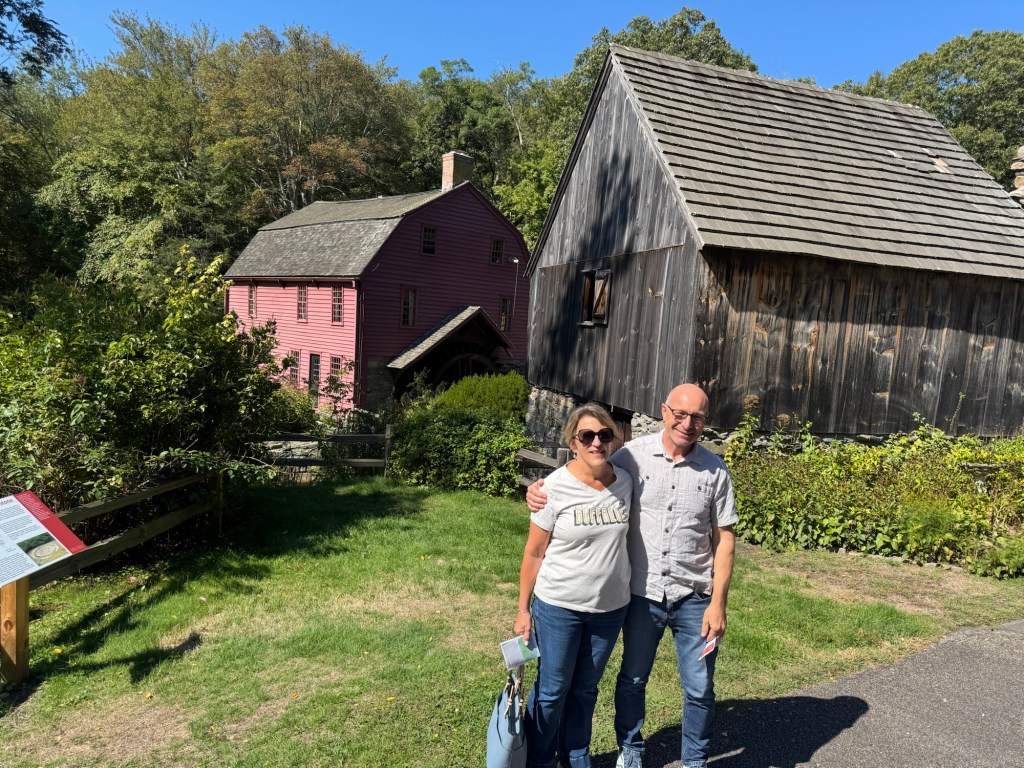
Then I got out of town. Drove Maddy to Cal Poly and then back home. The next day I jumped on a plane to Providence for work. Glen flew out at the end of the week and we spent the weekend (our first as official “empty nesters”) with my cousin playing tourist.

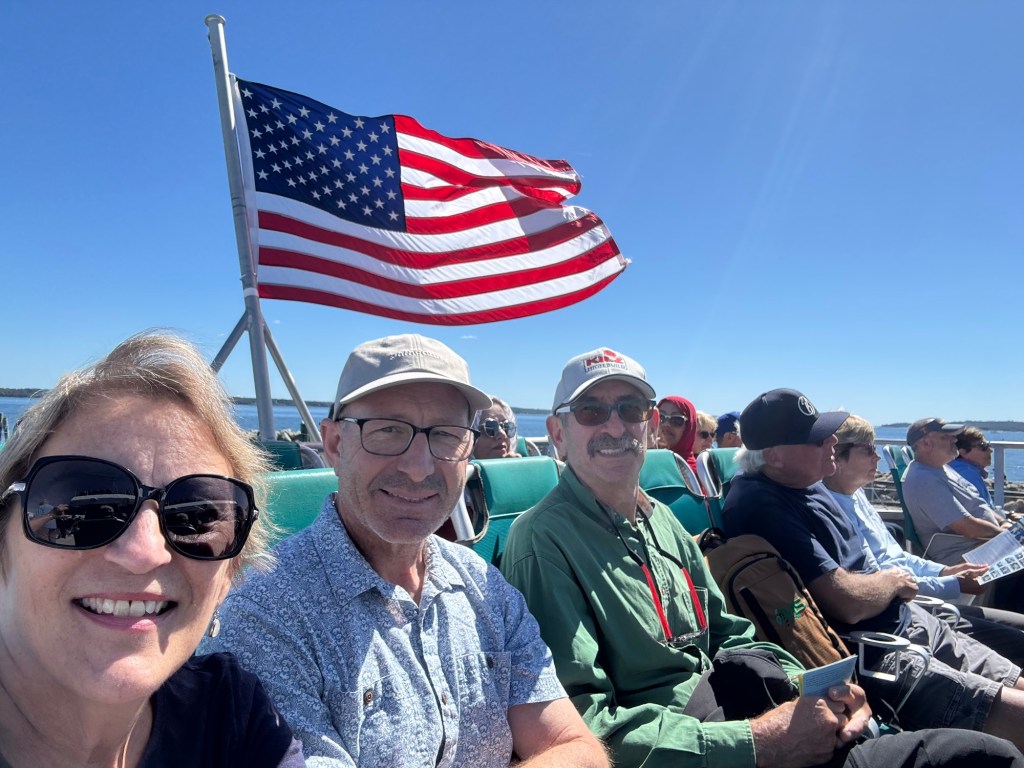
Beautiful fall weather made a boat tour of light houses on Naragassent Bay just delightful!

We got home late on a Sunday and Monday morning at 9am I had my first radiation treatment.

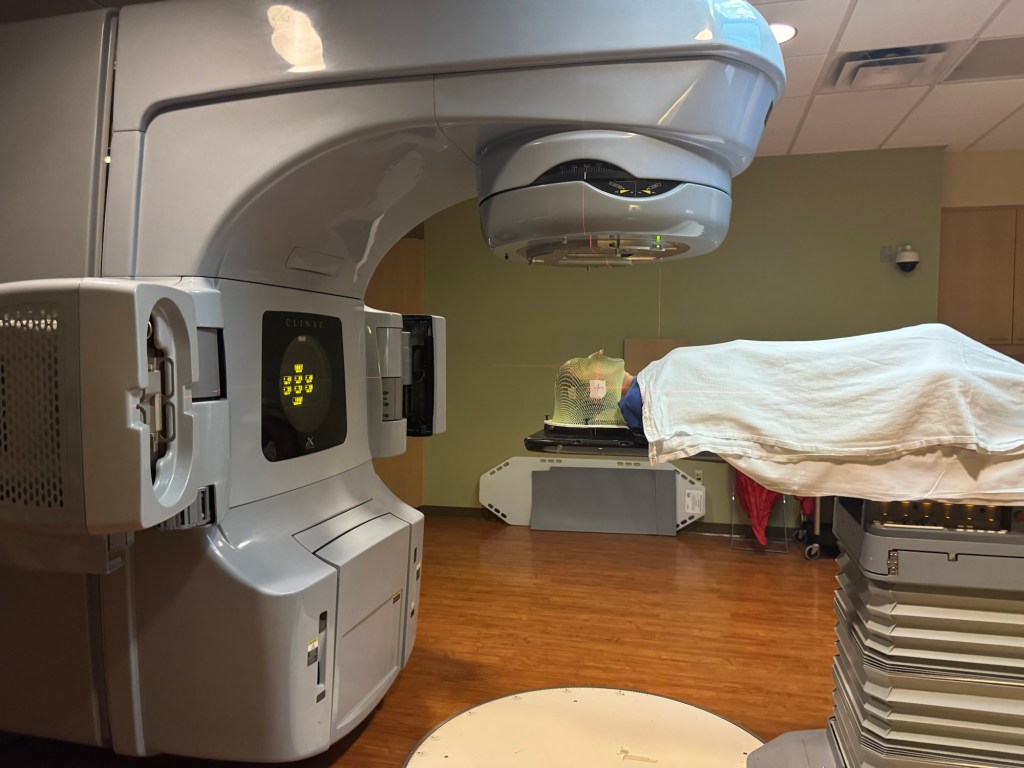
The photo shows me right after they finished a treatment. The mask mostly feels like a heavy blanket with a lot of holes draped over your head.

The mask is literally snapped to the table. You can’t move your head at all. You can kind of see through the holes and of course you can breathe. The round equipment above my head rotated all the way around the table that I’m lying on.

I had 10 treatments (M-F) over two weeks. Within those 2 weeks I also had my Enhertu infusion and got my flu and COVID boosters.

As soon as I finished radiation I headed back to the east coast, Washington DC this time to advocate on the Hill for funding for cancer research.

It’s been a lot, however, I refuse to let cancer dictate my life. Most of those days I was in bed before 9pm. I’m grateful that my side effects are minimal and I can still do “all the things”.

The side effects of radiation to your head are not pleasant. This week I developed a wicked sore throat to the point that I couldn’t swallow. Food doesn’t taste like anything. My fatigue has been ridiculous.

October is a little more quiet but more travel for work and fun.

I hope you all are living your best life and doing the things that make you happy and matter to you, whatever that might be.

Onward!

Think Before You Pink – Support Research 🔬

October 1, 2025

When we moved to Colorado 16 years ago and I went to get my car license plates updated, I was asked if I wanted a “specialty plate”. There was one for breast cancer and I had been diagnosed only 6 months earlier.

“What does the extra $60 for the breast cancer specialty plate go toward?”

Clerk: “Um, I don’t know I think it’s just so you can raise awareness.”

“No thanks” – hard pass! They were collecting money that in no way went towards breast cancer at all.

Today is the start of Breast Cancer Awareness Month (BCAM) and you will see pink everywhere. I think it’s very important for people to be aware of cancer. However, at this point I’m pretty sure everyone in the U.S. is aware of breast cancer – how can you not be when you are confronted with pink at every turn!

Any business – or person – can “support” BCAM and do whatever they want with any money they might raise or collect.

Before you “round up” your groceries for BCAM or donate to a fundraiser, find out where that money is going.

If you are inclined to financially support BCAM, consider focusing on organizations that support scientific research of breast cancer. Scientific research is how we get treatments and how we understand how exactly breast cancer behaves. (Spoiler alert: we still don’t know how breast cancer behaves.)

Charity Navigator is a great resource to see how organizations use their funds (administrative costs vs. programming).

My favorite organizations focus on research mainly for stage 4 breast cancer (Metastatic Breast Cancer, MBC), they are listed below. Did you know?

  • Stage 4 (metastatic breast cancer MBC) is the ONLY breast cancer that kills.
  • 30% of people “cured” from early stage breast cancer will eventually have a recurrence as Stage 4.
  • MBC is a terminal diagnosis.
  • If we cure stage 4, we cure everyone. Full stop.

If you’d at least share some of this information with one other person that would make me happy beyond belief.

We need more breast cancer research and especially stage 4. My life and the lives of my MBC friends depends on it.

METAvivordonate on my page

Breast Cancer Research Foundation

Sikora Research Lab (donate or learn about a group I co-founded)

Lobular Breast Cancer Alliance

September update

September 22, 2025

It’s been a bit so a short update here. Short version: currently stable, minus a pesky tumor in my C1.

I had a PET scan earlier this month. I met with my oncologist today and the imaging didn’t show any change. I’ve been feeling pretty well lately so that is a good sign. My tumor markers keep climbing which is worrisome but there is no evidence prompting a change in medication since my imaging doesn’t show anything. I’ll continue on Enhertu for the next 3 months.

I do have a tumor in my C1 and compared to June it’s a bit more active. It’s possible that this is the reason for the rising tumor markers – it’s hard to say. I’m having radiation on the C1 (started today). More on that later.

Overall, I’m trying to stay active and have balance in my life. I think that’s hard for all of us, cancer is just one more thing to navigate.

We are officially in fall – hopefully you had a great summer and fall is off to a good start.

Onward!

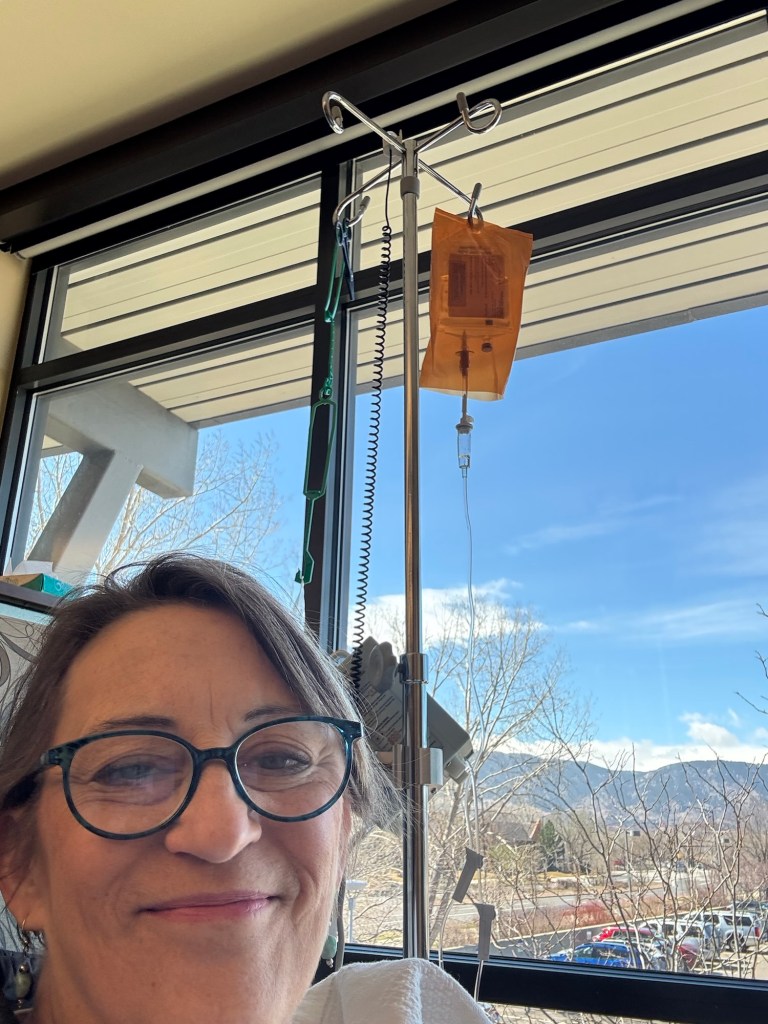
Grateful for walking paths from the cancer center. I took a walk before my appointment today.

The First 6 Years 😍

July 30, 2025

This month marks my living with metastatic breast cancer for 6 years.

Six years with a terminal illness.

I’ve been reflecting a lot this month both on this unwanted journey and life overall. I’ve had the privilege of:

  • 2,190 days including sunrises and sunsets
  • 312 weeks
  • 72 months
  • 6 years

And that included:

  • 1 Hospitalization
  • 2 Support groups I created
  • 4 Lines of treatment
  • 6 Cancer related surgeries
  • 7 Cancer related conferences attended
  • 50+ Scans of my body or parts thereof
  • 106 Blog posts
  • 150+ Doctor appointments
  • 170+ People connected with in support groups I started

That is a lot of cancering! There have been highs and some very low points. Fortunately, my cancer only got somewhat out of control once. For the most part I’ve been fortunate to tolerate medications well, have minimal side effects, and be surrounded by an amazing medical team and an incredible new group of friends I’ve met because of cancer.

As you all know, cancer is but one part of my life, even though this blog is cancer-focused. I’m proud of all I’ve accomplished over the last 6 years. The big moments and the small ones too. Every moment adds up to life. It wasn’t always easy, but who ever said life was easy?

Some highlights:

  • 1 Global pandemic
  • 2 Countries visited
  • 4 Graduations attended
  • 5 Colorado weekend getaways
  • 6 Nutcracker ballet performances attended
  • 13 States visited
  • 30+ Visitors here to Colorado
  • 34 Trips in the U.S.
  • ? Meals out with friends = too many to count

I will never say that cancer is a gift.

Cancer also did not change the way I live my life and how I prioritize. I was already doing that just fine thank you!

It has pushed out opportunity to do some things and so the choices I make on how to spend time is especially important.

I hope you reflect on your last 6 years and find it filled with amazing experiences, wonderful people, and quiet moments.

Onward to the next 6 years!

A few photos from the first 6 years of living with MBC –

It’s Summer & I’m Feelin’ Fine ☀️

July 13, 2025

Hi all – it occurred to me I haven’t shared an update in a while so here we go. 

It’s been a busy spring and summer. Maddy graduated in May and had dance commitments through June (she’s actually still dancing in July. Evelyn finished her junior year and started a summer research internship at University of Colorado Anschutz Medical Campus (studying lobular breast cancer). Both the girls are studying engineering in college.

I’ve been trying to keep up with it all. In May I started doing Pilates regularly in addition to my daily walking. So far it’s been helpful with gaining back some strength, especially in my core. 

Overall, I’ve been feeling quite good. I have some pain occasionally between my shoulder blades in my thoracic spine but that could be how I sit at my computer, or the Pilates, or the cancer, or something else. It’s manageable and isn’t persistent so I don’t give it much more thought. 

I was having some vertigo on and off in May and so an MRI of my brain was ordered. (That’s the thing about metastatic cancer, any small thing could be something big – or not.) Fortunately the brain MRI came back clear – yay! (Note: previously I thought that there was new progression on my C1, however, my oncologist confirmed it’s not new, it’s been there or quite some time. This is good!)

I was due for my 3-month PET scan and had that in mid-June. (Read more about PET scans here and how they are used to monitor my disease.) 

The results of the PET scans were mixed. Some of the lesions in my spine showed healing, others showed active cancer. 

So, what do we do with that? 

Since I’ve been feeling fine and I have a very good quality of life on Enhertu, we stay the course. I’ll continue taking Enhertu until we get solid evidence of significant progression. 

My (very reliable) blood work tumor marker numbers are climbing high. For now we will just keep an eye on things since it’s not clear the cancer is significantly active.

It’s counterintuitive that the treatment is working in some areas and not in others. You’d think it would be one or the other – but that is what makes metastatic breast cancer treatment a bit of an art. The oncologist has to weigh all these different factors and decide what the smartest path forward is. 

My plans for the rest of the summer (besides work) will mainly be going for walks, doing Pilates, water color, some crocheting, maybe some gardening and trying to connect with friends for lunch. 

I hope you are soaking up all the hours of daylight we have this season and are living the hell out of life!

Onward!
All About PETs 🐱

No, this is not all about Toulouse, but it could be! He’s such a good little furry guy!
Toulouse ❤️

In case you are interested, I’m summarizing how a PET scan can help us monitor metastatic breast cancer. If you are not in a science-y mood, you might want to pass on this post.

A PET (Positron Emission Tomography) scan is often used to detect cancer. It is also commonly used to diagnose heart disease and brain conditions. With cancer it is used to determine if the cancer has spread to other parts of the body (metastasized). [Tomography = a technique for displaying a representation of a cross section through a human body or other solid object.]

A PET scan detects cellular changes in organs and tissues earlier than CT and MRI scans. The scan is painless, although sometimes people can feel claustrophobic as their head moves through the large tube. The machine used to do the scan is shown in this diagram from the Cleveland Clinic.

Machine used for PET (and CT) scans (image from Cleveland Clinic).

Prior to the scan, an injection of a glucose-based radiotracer is given. A person has to wait about 45 minutes after the injection before the scan is started. This gives the radiotracer time to circulate through the blood stream and body. 

A PET scan can take 30 minutes to 2 hours depending on what exactly is being examined. The radioactive tracer allows the machine to detect diseased cells. Diseased cells will uptake (or collect) more of the glucose radioactive tracer because they are more metabolically active than healthy cells. This increased uptake is visualized as brighter spots on the imaging.

The most common radiotracer used in PET scans is fluorodeoxyglucose (FDG).  Once it’s inside the cell, it’s trapped. The PET scan machine can quantify the amount of tracer uptake using SUV. SUV (Standard Uptake Value) is a quantitative measure used to assess the concentration of the tracer. 

SUV represents the ratio of the amount of radioactive tracer in a specific region of interest (like a tumor) to the amount of tracer that would be expected in a similar volume of normal tissue, taking into account the injected dose and patient’s weight. 

Changes in the SUV number over time can help determine how well a patient is responding to cancer treatment. 

In an imaging report, SUV numbers are reported. The radiologist or oncologist can then compare the SUV numbers to previous PET scans to determine if the cancer is more active (higher SUV number) or less active or inactive (lower SUV number). 

While all of this sounds very concrete and specific, it’s still just an approximation of what is happening in the body. Results from a PET scan are used along with other factors such as how an individual is feeling, whether or not there is pain present, and blood work results. 

PET-CT

Sometimes a PET scan is done in conjunction with a CT scan. The same machine does both of them and a patient would have both done during the single scanning session. The combination of both a PET and CT scan produces a three-dimensional image that allows for a more accurate diagnosis. 

A CT scan is Computed Tomography and uses x-rays to get a detailed view inside the body. It produces still images of organs and body structures (such as bones). Sometimes it’s referred to as a CAT scan – it’s the same thing. CAT = Computed Axial Tomography.

Instead of creating a flat, 2D image, a CT scan takes dozens to hundreds of images of your body. To get these images, a CT machine takes X-ray pictures as it revolves around you.

After a scan is completed, the technician makes sure the images look ok and then it is sent to a radiologist to interpret and read. The radiologist writes a report of what they see, ideally comparing it to previous PET or PET-CT scans. That report is then forwarded to the oncologist and the patient. The oncologist and patient, together, determine what changes to make to treatment (or not) based on the scan results as well as other factors such as how the patient is feeling and blood work.

February 21, 2022 – Help me take action

Living with cancer shines a light on many things that the average person is not aware of.

In America, our health insurance is largely tied to our jobs. If you get a cancer diagnosis you may not be able to work and therefore lose your insurance. The irony is that when you need insurance most, it’s hardest to get.

Did you know that If you have stage 4 breast cancer and need Medicare there is a 24-month waiting period? There is also a 5-month waiting period for Social Security Disability Insurance benefits.

Statistics on how long people survive with stage 4 breast cancer is unclear*. Previous statistics showed the average survival rate was 2-3 years. Yet there is a 24 month waiting period to get Medicare coverage. See the math problem here?

You can help me get the attention of lawmakers. It doesn’t even require a phone call.

The Metastatic Breast Cancer Access to Care Act (S. 1312/H.R. 3183) would amend the Social Security Act to eliminate waiting periods for social security disability insurance benefits (SSDI) and Medicare coverage for eligible individuals with metastatic breast cancer.

You can support this act by filling out this online form. It will generate a letter to your elected representatives. I just did this and it took all of 5 minutes. Click on the text below.

*Survival rates for stage 4 breast cancer is messy. The introduction of CDK 4/6 inhibitors in 2015 was a game changer. It increased life expectancy significantly. In addition, people diagnosed with stage 4 breast cancer are not counted in national statistics until they succumb to the disease. That is another post by itself.