Metastatic Breast Cancer Awareness Day

October 13, 2025

Today is Metastatic Breast Cancer Awareness Day. We get this one day in breast cancer awareness month to shine a light on MBC.

1 in 3 of women cured of breast cancer
will be diagnosed as stage IV (MBC), which is terminal.

If we cure Stage IV, we cure all breast cancer.

In support of raising awareness for MBC, I went to Washington D.C. last week and participated in the METAvivor Stage IV Stampede and Summit.

The Summit included a day of education about MBC as well as how to advocate for various bills and funding.

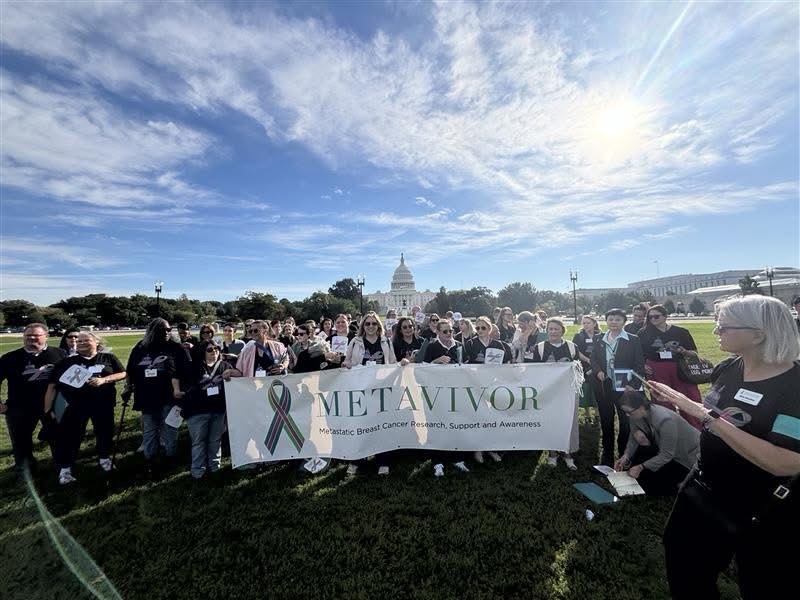
Tuesday we marched (with police escort) from our hotel to the Capitol. We had a remembrance on the grass. I am holding the sign on the end, near the last “R”. We spoke the names of those who have died from MBC (and I included my aunt Jeanne Moretti as well as several other friends who have passed).
Policy advocates preparing to visit with Congressional staffers.

We met with staffers of our elected representatives. Staffers were taking meetings even though the House was not in session and the federal government was/is closed.

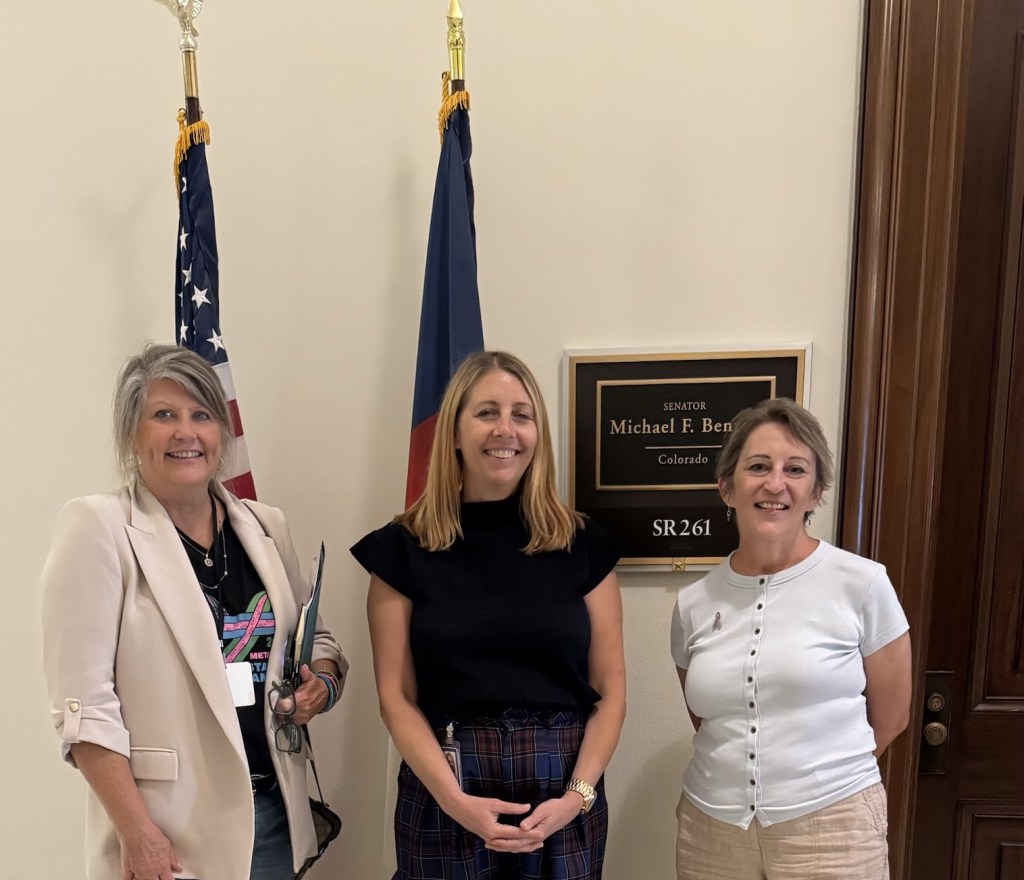
There were four “asks” that we made. I had fantastic interactions and felt like I was heard. I’ll share here what those asks were – if you feel compelled to share with friends/family or to reach out to your own elected representatives that would mean a lot.

  • Did you know that if you have MBC and need to stop working there is 5-month waiting period for Social Security Disability Insurance (SSDI) benefits to start? In addition, after that there is a 24-month waiting period before you are eligible for Medicare! I am one of the fortunate people who is living longer with my MBC diagnosis and can still work. Women with different subtypes have a prognosis of 2-3 years. During this time they can’t work and can’t get SSDI or Medicare. House bill 2048 “Metastatic Breast Cancer Access to Care Act” would eliminate the waiting period.
  • Did you know that where you live impacts how private insurance pays for MBC drugs? Private insurance treats medication received at a cancer center different from medication taken at home. Recall that I was on a pill (Ibrance) for the first 4 years. I live in a state where private insurance is required to pay for this (chemo) regardless of how it is given: intravenous or a pill. House bill 4101 (Cancer Drug Parity Act) would require private insurance to cover oral cancer drugs the same as IV drugs, regardless of what state you live in.
  • The U.S. is the largest funder in the world of cancer research. The administration’s budget zeroed out some breast cancer research programs and greatly reduced funding for the National Institutes of Health (NIH). Fortunately, Congress likes science – we asked them to provide the NIH with the same funding as last year and restore the breast cancer program in the Dept. of Defense.
  • Did you know there is a national database of incidence of cancer? It was created in the ‘70s during the Nixon administration. Unfortunately, it has not been updated since then. The Surveillance, Epidemiology and End Results (SEER) database provides information on cancer statistics which is used to inform where research dollars should go. It needs to be updated badly and I asked our reps to support funding for it. SEER help us understand where there is a high burden of cancer. It turns out that not every state is contributing to it. In addition, it does not include any recurrence of cancer. When I was first diagnosed, my information was put into SEER (LCIS and stage 0 DCIS breast cancer). However, there is no mechanism to update my information! According to SEER I was treated in 2009 and all is good with me. As you can see, the number of people with MBC or with any recurrent cancer are not counted which means we have no idea who is living with metastatic disease (unless you were diagnosed with MBC right away, which is only 6% of all MBC diagnoses).

That was a lot! If you are still reading, thank you. If you’d like more information about anything including language to send to your elected representatives, shoot me an email (charlevo@gmail.com).

I have one other cancer event this week and then I will take a break from cancer the rest of this month. I hope you are keeping balance in your life as well.

Onward!

1. Donate to research for MBC via METAvivor.

2. Find your Congressional representatives: House & Senate

Summer, Scans & Science

June 4, 2025

Happy summer my friends. In Colorado we are starting off with a cool, wet one which is great for the a/c bill but less ideal for exploring outside.

Lot’s going on here including medically.

I had some work travel last month and towards the end I started not feeling well, including being light headed. I mentioned this to my oncology nurse 2 days ago during my treatment appointments and she scheduled a brain MRI and echocardiogram. Yes, light headedness triggers the immediate thought of brain metastasis.

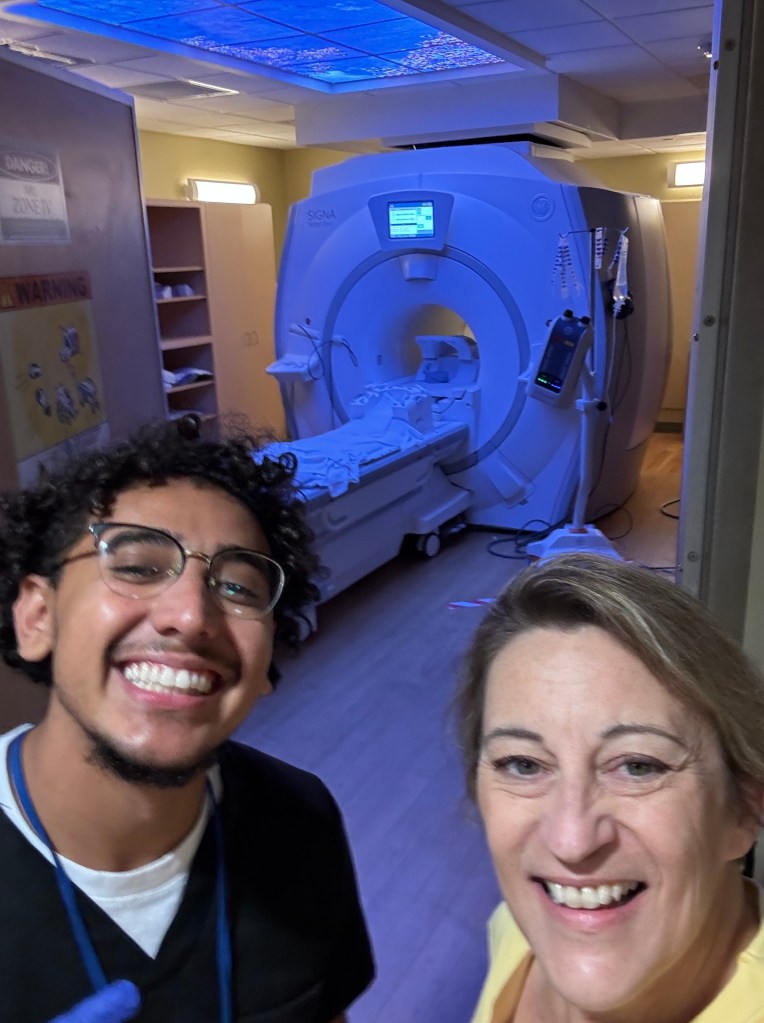
Recall from my last post that we’ve found the MRI to be the best imaging for me. The brain MRI captures the head and top part of the spine (cervical). Mixed results: no brain metastasis 🙌 but it did pick up a new lesion on my C1 vertebrae 👎.

The nerves that come out of the C1 impact the sides of your face and head as shown in this nifty diagram (one of my fav diagrams BTW).

The most likely explanation for my light headedness is that the lesion (tumor) is pressing on the nerves. So, my oncologist has ordered another PET/CT to check again. It seems a little insane to keep getting imaging that doesn’t work so well – I guess he wants to confirm or look for other lesions.

My tumor markers did drop the end of last month which is in contradiction to the new tumor.

See how complicated and tricky cancer is?

For now, I’ll get the PET/CT and an echocardiogram and keep doing all the things (eating healthy, moving, relaxing) and we shall see where this takes me.

After my work trip I spent 2 days in Chicago at the American Society for Clinical Oncology (ASCO) where I learned about new treatment lines coming out and connecting with other patient advocates.

The cancer research going on now will result in the drugs being used in the coming years. This is why it is so important to preserve funding for the National Institutes of Health. The presidents budget slashes funding by almost 50%. That means many fewer clinical trials and many fewer drugs in 5 years. No one expects to get cancer. If you get cancer in 5 years you will be wishing the NIH had done more research to help you. Please call your elected federal reps and push for restoring funding to NIH.

On a lighter note – Maddy graduated from high school, Evelyn started a research internship at University Colorado Anschutz Medical Campus and we all head to Las Vegas at the end of the month to support Maddy in her last National Dance Competition.

Onward!

Cancer Drugs 💊 and Research 🔬

April 19, 2025

Hello friends and family! A quick update on things cancer-related, as you can expect from this blog!

My hip is fantastic. No pain at all. I’m up to walking around 4 miles a day. I can manage about an hour at a time. So happy about that and grateful for the skill of my orthopedic oncologist Dr. Lerman.

This coming Monday morning I will have treatment #21 of Enhertu. Recall this is a drug called an Anti-body Drug Conjugate (ADC) and is given intravenously every three weeks. Overall this drug has been good to me. It brought me back from the brink of a run-away cancer train early last year. Recently it’s not clear it’s been working so well as I mentioned in this post. Recall also that this drug was approved for my type of breast cancer (Her2-low) only in August 2022 – a full 3 years after I was diagnosed with MBC. I’m hoping for more drug discovery and approval so I can live longer!

I’m grateful that my side effects continue to be minimal. I’m on a blood thinner because it caused a blood clot last fall. I take Olanzapine nightly to control nausea and vomiting. I’m also grateful for the researchers that looked into this particular use of Enhertu. So very grateful!

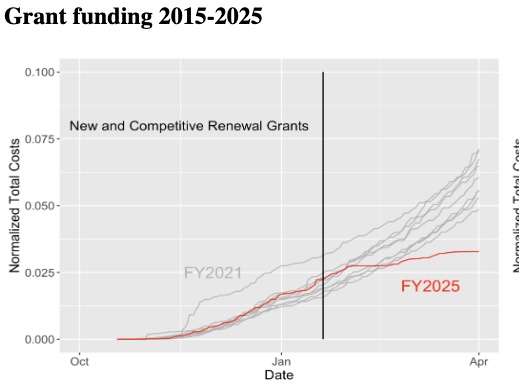
This brings me to my second update. The future of cancer research in the U.S. is at risk. I know this first hand as a researcher I work with is looking at a loss of funding from NIH for his basic lobular breast cancer research. He shared some of the graphics and information shown here.

This chart shows the trends of NIH grant funding from 2015-2025 (source). As you can see, the amount of funding being distributed is far below previous years. The spring months (Feb-May) is when most federal awards are made based on the budget cycle.

Screenshot

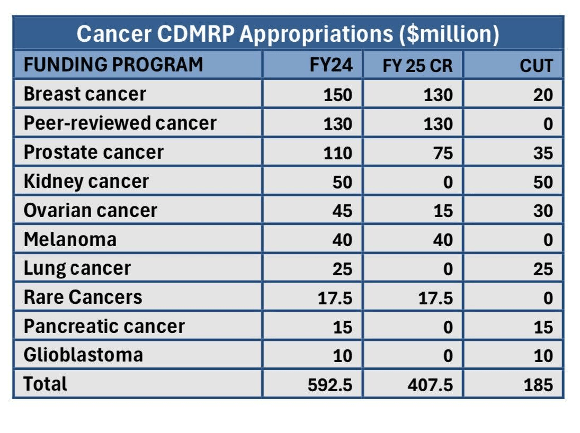
The outlook for the Congressionally Directed Medical Research Programs (CDMRP) show significant cuts to cancer research. The March 14 Continuing Resolution has their budget reduced by 57%. You can see from this chart where some of the cuts were.

You may say, well ok, but there are a lot of other sources of funding for cancer research. There are other countries who will continue research – we don’t need to worry. Not really. As you can see from this chart, the NIH is BY FAR the largest funder of cancer research IN.THE.WORLD! The budget of the NIH is significantly larger than the next largest funder.

Ok, you say – what about foundations? They also support research. Yes, they do. The amount that they spend is a fraction of what the U.S. Federal government spends. In addition, the dollar amounts from foundations tend to be small. The motivation of foundations is to provide seed money to develop a proof of concept. Once the researcher does this they have some preliminary data to seek out a federal research grant to do the main research. The foundations take on the risk that federal funding won’t.

Well, Donna, thanks for giving me such uplifting news. Now I feel sad. Well, I can help you feel better about all of this by – please – contacting your federal elected representatives and urge them to restore funding to the NIH. You can find their contact info here. If you scroll down past the photos you can see a script to follow when you call.

All this being said, I remain cautiously optimistic that Americans will band together and convince our reps to fund cancer research. You never know who will get cancer next and having new treatment options is critical.

Onward!

Script for federal reps:

Hi, my name is [Name] and I’m a constituent from [Your city].

I’m calling to urge [Name of representative] to oppose the recent devastating cuts to NIH funding and staffing. These cuts are already disrupting crucial research to treat diseases such as cancer [you could also add Alzheimers, diabetes, other diseases that impact you]. Hurting the NIH hurts everyone.

Thank you for your time and consideration.

p.s. If you leave a voicemail be sure to leave your full street address to ensure your call is counted.

p.p.s. – If you are nervous about talking to a person, call in the evening and leave a voice mail. It still counts.

Please help end restrictions on National Institute of Health ❤️‍🩹

Hi everyone –

It’s been an interesting week, regardless of who you are and what you support. I’m writing because one of the Executive Orders this week puts a freeze on communications from many Federal agencies including Health and Human Services (HHS) and the National Institute of Health (NIH).

This is a serious situation as it is already putting cancer research at risk. I work closely with a breast cancer researcher at the University of Colorado (Dr. Matt Sikora) who conducts basic research through grants from NIH. Based on communications he received, it looks like his research lab may lose funding. This funding supports the basic cancer research that leads to new treatments. We all know how I feel about new treatments!

Well, that is a lot. What can I do as one individual?

I ask that you take 10-15 minutes to send an email to your elected members of Congress (you have 2 state Senators and 1 Representative). Believe it or not, staffers count the number of communications they get from constituents on a particular topic. While you might get a form letter response, don’t get discouraged. They will count your email! It will make a difference.

To help you, Dr. Sikora has drafted a sample email and provided links to find contact info for your elected reps as well as a link to where you can find the economic impact of cancer research in your state.

I’m happy to help anyone if you need it. Thanks for your consideration. Cancer has long been a non-partisan issue and should stay that way.

Onward!

Sample email text (you need to change things in bold)

Dear [congressperson]:

I am writing due to grave concerns with the freezing of communications at Federal agencies. Specifically, I am writing regarding HHS and the National Institutes of Health, including the indefinite suspension of council review meetings, review study sections, and travel. Suspension of these meetings and review sections jeopardizes biomedical research funding nationwide.

Currently, our state of Colorado receives nearly $600 million in funding for biomedical research from NIH, supporting over 7,000 highly skilled jobs and driving over $1.5 billion in economic activity. As a concerned constituent living in [Denver], and as a [patient living with cancer/research advocate/caregiver/etc], I urge you to make sure that money that has been allocated for NIH extramural funding, including all training and workforce development grants, remains committed. Loss of this funding would be disastrous for our local economy, and would drive major job loss including in highly trained university biomedical research personnel, including graduate students and postdoctoral trainees that make up the next generation of biomedical researchers.

NIH has always benefitted from robust bipartisan support, and I urge you to continue to commit Federal support to the NIH mission and extramural program, which ensures that our nation remains at the forefront of biomedical research innovations and advances in patient care.

Sincerely,

[name]

–Other state funding data can be found here: https://www.unitedformedicalresearch.org/nih-in-your-state

— Reps by address can be found here: https://www.congress.gov/members/find-your-member